




 Back
Back











Modern enterprises handle sensitive data across numerous cloud applications, distributed workforces, and AI initiatives. This widespread presence of data—in motion, at rest, and in use across many channels—creates significant security blind spots, elevating the risk of data exposure and exfiltration.
When security teams receive an alert relating to data security, there’s a consistent lack of insight into the journey of the data concerned—how did it come to be in this risky position? And there are almost always gaps in the broader context of how data has been accessed and handled that would add significantly to the investigatory process.
To navigate a complex threat environment, organizations need to answer critical questions such as: Where did the data come from? Where did it originate? What happened to it along the way?
The answer lies in a powerful, yet often overlooked concept: data lineage.
What is data lineage?
Data lineage is the process of tracking a dataset’s journey from its origin to its current or final destination. It’s a digital breadcrumb trail that documents how data is created, transformed, transmitted, and used throughout a system. It provides a clear picture of data flow, helping organizations understand where data comes from and how it has changed over time.
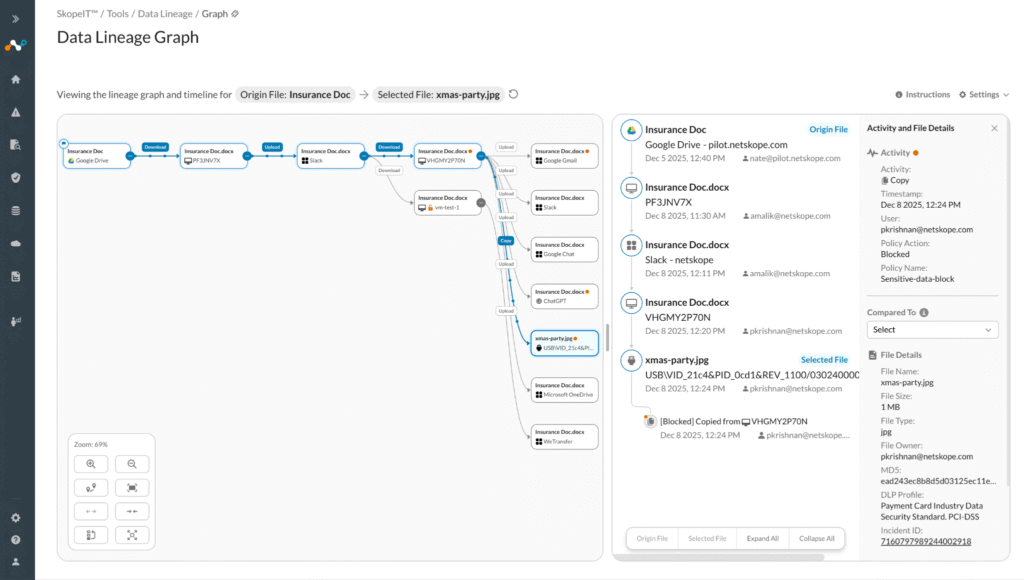
Here’s a common example: A sensitive file (perhaps it’s a customer database), is downloaded from Salesforce by one employee, emailed to a colleague, who then uploads it to a personal Box. Without data lineage, this is a disconnected series of events related to the same dataset. The investigatory process inevitably focuses on the final stage—the upload to Box—and misses the value of spotting and addressing contributing factors long before the final security policy was triggered. But with data lineage, you see the full, interconnected story of the data’s movement and use. This capability provides crucial visibility and context, allowing you to investigate suspicious activity by insiders, rapidly determine the reasons why data is in use, and prevent unauthorized data movement.
Netskope’s unified approach to data lineage
This is where Netskope is uniquely positioned. The new Netskope One Data Lineage product, part of our unified Netskope One Data Security solution, provides unprecedented end-to-end visibility. It leverages existing events, and links incidents to data lineage from sources like inline CASB, and endpoint security.
Unlike fragmented, legacy security architectures that create blind spots, Netskope’s approach:
- Correlates activity across all channels: We bring together data from web, email, SaaS, endpoint, private apps, and IaaS to provide a holistic view of data interactions and movement. Data lineage correlates activity across sources, users, and data interactions to provide end-to-end visibility into data movement.
- Extends policy enforcement: The context derived from data lineage, such as file origin, user, and activity, can be used to set up preventative policies that complement traditional DLP mechanisms.
- Leverages industry-leading DLP: Netskope has the market-leading DLP engine, along with data discovery and posture management (DSPM) capabilities, providing the perfect environment for customers to expand security to include data lineage. We also have more than 3,000 data identifiers and patented AI/ML techniques.
This unified approach strengthens our position as a leader in securing data for the AI era by directly addressing pain points like insider threats, data exfiltration, and compliance risks.
Why this matters for your organization
In a world where AI usage is skyrocketing, securing the full AI stack (applications, data, and infrastructure) is no longer optional. Data lineage provides the crucial context needed to mitigate these new risks.
By adopting a unified platform with data lineage capabilities, you can:
- Mitigate insider risk: Gain insights into data movement and risky activities by insiders, uncovering threats from personal apps, email transfers, and bulk downloads.
- Accelerate investigations: Quickly investigate any suspicious activity by insiders, reducing the time spent on manual detective work.
- Achieve compliance: Simplify adherence to regulations like GDPR, HIPAA, and CCPA with built-in compliance frameworks and automated policy enforcement.
- Reduce complexity and cost: Eliminate legacy tools and reduce complexity, achieving cost savings through the Netskope One converged platform.
Instead of just reacting to data incidents, data lineage helps you to proactively defend against— and disrupt—threats by understanding the complete story of your data, everywhere it goes.
To learn more about how Netskope can help, set up a demo or discussion with our experts or visit the Netskope One Data Security page or the What is Data Lineage? page.


 Read the blog